lizbee: A sketch of myself (Default)
Round-ups from previous years: 2021, 2022, 2023

This year I kept a media-tracking spreadsheet in Google Docs, and also a paper reading journal. Which sounds extremely wanky, because it is, but I enjoyed the tactile aspect of creating layouts, pasting print-outs of covers, and keeping track of things in handwriting. Also I got to use stickers. Here are a couple of sample pages:
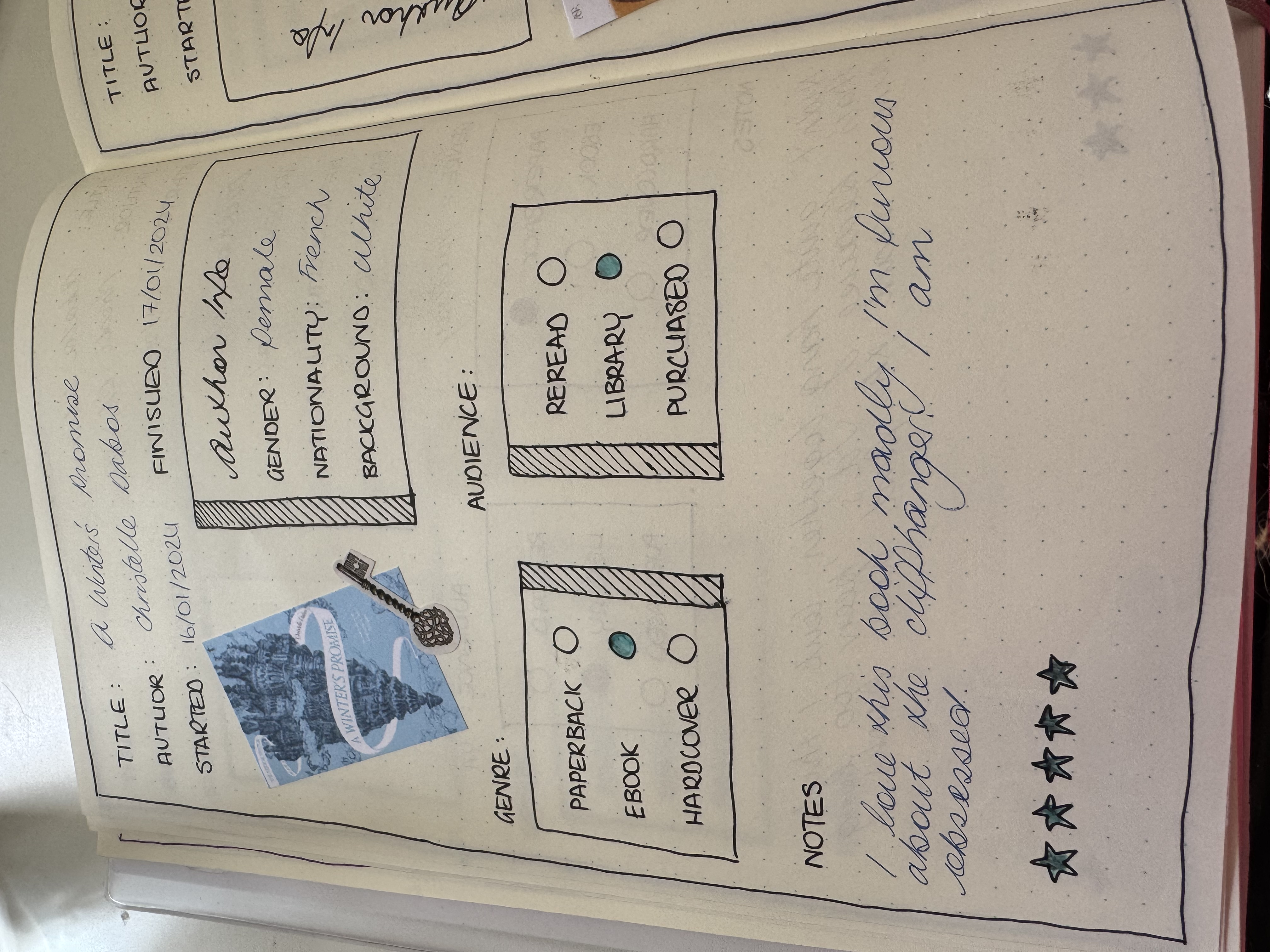
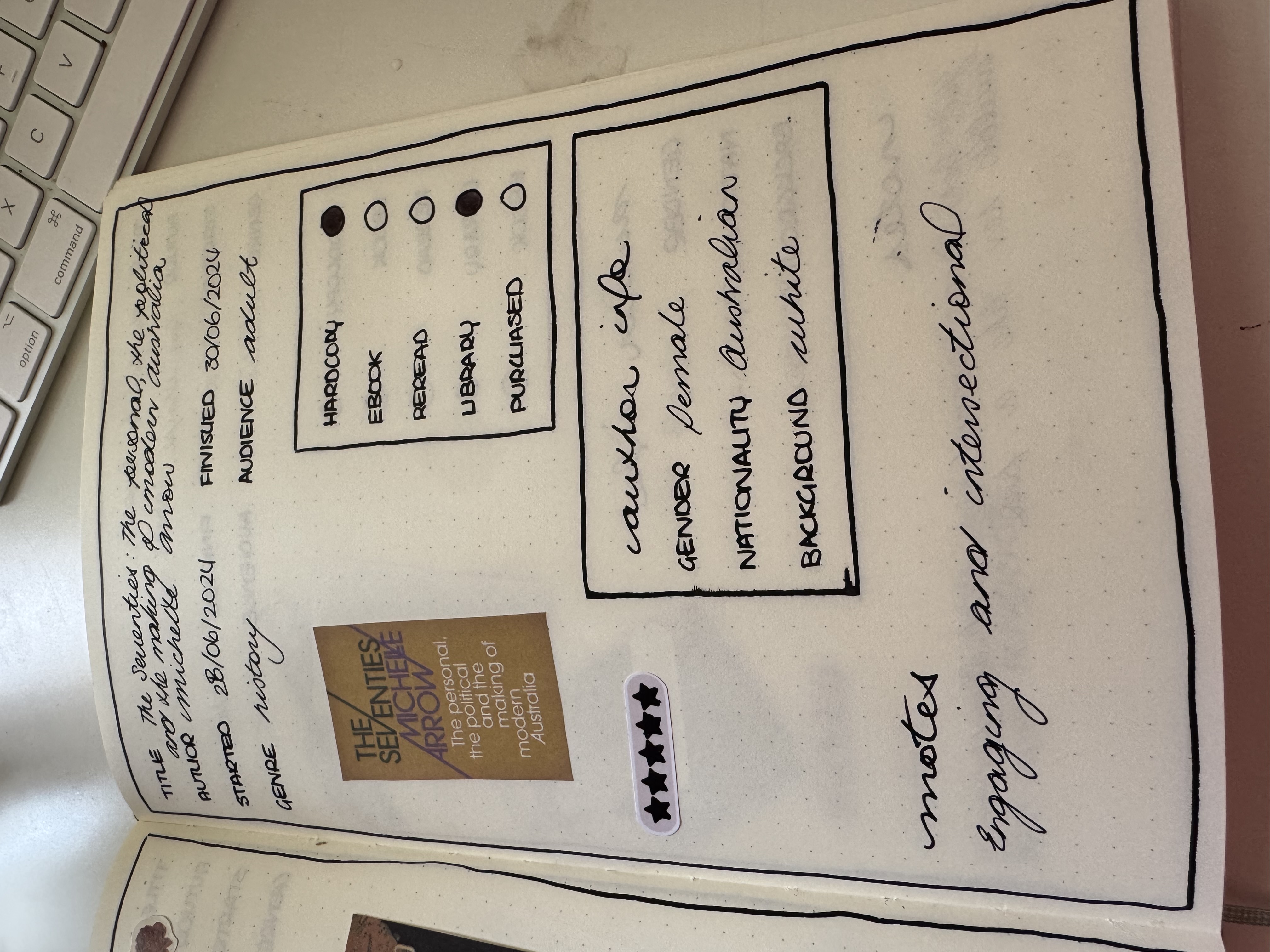
A photograph of a page from my reading journal, with handwritten notes. A photograph of a page from my reading journal

I've already started a fresh journal for 2025, this time in a small ring binder to avoid certain annoying problems, ie, the build-up of thickness from pasting the covers into the same spot over and over again.

Okay, the stats.

Total books logged: 138 (the secret to my success: sprained ankle, broken ankle, covid, ongoing ankle problems and plantar fasciitis have made it more likely that I will stay in the office and read at lunch instead of taking a walk)
DNFs: I didn't keep close track, but a standout is a YA quartet I abandoned 20% into the third book

By target audience (age)
 
  • Adult - 86
  • Children - 1
  • Young Adult - 42
  • Middle Grade - 9
And my favourite category, by genre and audience
 
  • Contemporary (adult): 7
  • Contemporary (YA): 10
  • Contemporary (middle grade): 2

What's great about "contemporary" is that it's really a setting, not a genre -- so these 19 books encompassed everything from Māori literary fiction to two books which are arguably thrillers and now I'm wondering if I hit the wrong option in the dropdown menu.
 
  • Fantasy: (adult): 8
  • Fantasy (YA): 11
  • Fantasy (middle grade): 4
Other than Christelle Dabos, I only read three YA fantasy novels from authors who were new to me -- and two were the quartet I wound up DNFing in book 3. (Respectfully, I think that if you are writing for young adults, you should not have more graphic on-page rape than George R. R. Martin.) It feels like the bubble has truly burst.

Contemporary mystery and thriller
  • Adult: 17
  • YA: 10
It feels like exciting things are happening in the contemp mystery genre right now, especially YA. Especially if, like me, you don't draw too much of a distinction between a "mystery" and a "thriller".

Science fiction
  • Adult: 6
  • YA: 6
Again, I feel like the YA SF bubble has burst, largely under the weight of too many Hunger Games imitations. Or maybe it just seems that way because I reread the Hunger Games novels.

Adult SF is where I found most of my DNFs this year, as I tried and failed to read more indie SF.

Non-fiction: 35

History was the winner here in terms of numbers, but for quality, I read a bunch of books about organisational and corporate shenanigans at Boeing, NASA, Twitter and Qantas, and those were the standouts.

Author stats


Australian authors: 18% - this is much lower than in previous years, but I made up for it by reading more widely throughout the world, with more books by New Zealanders and Nigerians, and what I think must be the first YA novel I've read by an Argentinian
Authors of colour: 26% - down from last year's 29%, and doing even worse in terms of "30% feels like equality if you're not marginalised"
Women: 67%, I do NOT need to make a deliberate effort to read books by women. Also three were books by trans women, and I need a better way of tracking that than putting an asterisk in the gender box in my reading journal
Trans and non-binary authors: 4%

The really nerdy stats

Library loans: 73% - I tracked spending for the first time this year, and spent a total of $479 on books, plus US$50 for my Queens Library membership.
Ebooks: 76% of my reading was ebooks, plus I read one (1) audiobook. Which is a format I do not care for, but it was the only way to get Black Against Empire from the library. (A stranger on Bsky tried to neg me by saying it's weird that I would have preferred to skim the chapters on Marxist theory, and I'm sorry, I think finding Marxist theory boring is a pretty common position.)

TV stats

For the first time, I tracked TV watching via spreadsheet. I can't tell you down to the minute how many hours of TV I watched, but I watched 69 different series (nice), most in English and most made in the United States.


lizbee: A sketch of myself (Default)
I actually just finished my 86th book of the year, which sounds impressive until you remember that a few months ago I sprained my ankle, and then I broke it, and then I got covid. I had a lot of time to lie around reading, is what I'm saying.

Anyway, I fell out of the habit of talking about my books here, because I already keep a spreadsheet and a paper reading journal, but here are some highlights, and also lights.

We Didn't Think It Through by Gary Lonesborough

Lonesborough is a gay Aboriginal man who writes YA about Aboriginal boys being complicated and messy and screwing up. He's a super important voice in local YA, and one who is actually read by teens. This is his second book, about a boy who steals the local white bully's car and goes for a joyride that ends up with the hero in juvie. How do you come of age and become a man when you're in prison? And what kind of man will you be?

I enjoyed this a lot, but -- as someone who is on the record as being against verse novels and against the causes of verse novels -- I think it needed more poetry. The protagonist is very much steeped in hip hop (he listens to Kendrick, as opposed to the white bully, who turns out to be a secret Bieber fan; if this book had been written just a year later, I think Bieber would have been swapped for Drake) and the classic Aboriginal folk and country music that his family listens to; a youth worker in prison turns him onto poetry. It's pretty clear that the publisher couldn't get the rights to quote the poems that become important to the hero, which is a real shame, but also I would have appreciated more of the hero's own poetic voice.

The F Team by Rawah Arja

You know how I'm always complaining that current YA doesn't give its characters space to be messy or hold bad opinions without stopping to reassure the reader that it's okay, they'll learn better? This book does not have that problem. I wanted to gently take the hero and his friends aside and go, "Boys, I'm gonna need you to be less antisemitic." Which kind of goes with the territory when you're reading a book about a group of Lebanese-Australian yoofs and their misadventures as they try -- initially half-heartedly -- to save their school (which is a real school, and its Wikipedia page is a trip) from closure.

When I was very small, my family lived in Sydney for a few years, and my class at my first school was almost 2/3 Lebanese-Australians. So I picked this up on a whim at the library, skimmed a few pages and was immediately transported back to my youth -- Arja has a great ear for dialogue and subtle class differences, as the boys come in contact with the more privileged boys of the Shire, and also earn the respect of the local teenage girls. It's a sports book in the most classic sense, but very enjoyable. And yes, the boys do learn to be less antisemitic as they help their new Jewish frenemy deal with the death of his father.

Into Thin Air by Jon Krakauer

Climbing Mount Everest seems to be a bad idea and no one should do it. But this was incredibly compelling, and I understand why it's a classic.

Flying Blind: The 737-MAX Tragedy and the Fall of Boeing by Peter Robison

I'm slightly ashamed of reading about air disasters the same way I'm slightly ashamed of listening to true crime podcasts, although at least no one has decided that all plane nerds are sending love letters to Boeing. (Probably because the stereotypical plane nerd is a bloke, although the world's leading air disaster blogger is a trans woman.)

Anyway, I also love a business disaster, and obviously Boeing provides both in spades. This was very interesting, very humane, not too heavy on the physics, and I kind of wish I hadn't read it a few weeks before I'm due to fly to New Zealand on a Boeing 737.

The entire Hunger Games series by Suzanne Collins

I don't think I've reread the first trilogy since Mockingjay came out, and it holds up really well -- although it has a lot more telling-not-showing than current YA, which has massively ballooned in size since the 2010s. Overall my opinions of the books are unchanged since my first read (Mockingjay in particular needed extra time for revisions, and I salute Collins for extracting herself from the "put out a book a year" treadmill, which obviously doesn't suit her writing), but I was struck by how perception of Katniss as a character has drifted away from the actual content of the books. I see a lot of people talk about her as a straightforward Strong Female Character, where it would be more accurate to say that each book leaves her progressively more broken and traumatised. Like, she spends two-thirds of Mockingjay passively watching and/or having trauma naps because she cannot cope with reality. Which doesn't make for compelling reading, but also isn't the uncomplicated heroine behaviour some readers complain of.

Anyway, I learned in the course of my reread that Collins lives in Sandy Hook, Connecticut, and suddenly her urge to keep returning to this universe made sense.

The Firekeeper's Daughter and Warrior Girl Unearthed by Angeline Boulley

Two historical novels (one set in the 1990s, the other in 2014, I'm sorry, let's all take a moment to feel old) about teenage First Nations girls in Michigan. They're connected -- the heroine of the second is the niece of the first book's narrator -- and really amazing. Probably my favourite reads of 2024 so far. Both are essentially YA crime novels, but the first book deals with drugs, and in particular the impact of meth; the second deals with stolen First Nations artefacts and bodies.

The big trigger warning is that the first book includes a sexual assault on the heroine. It's rough! But also earned? I tore through these books in a couple of days, and at this point will read anything Boulley puts out.

lizbee: A sketch of myself (Default)
Five days ago, I posted this to Facebook: 

'I started Babel by R. F. Kuang yesterday at lunchtime, and I'm now 53% through. It's a 600-page ebook, but I literally could not put it down. I had my iPad propped up on the vanity as I brushed my teeth last night.
 
HOWEVER. It is possible that is ... I won't say "bad", in fact I think it's very good, but is it maybe a bit overrated? Not as groundbreaking as it's made out to be?
 
This might just be that I'm a Humanities person and a lot of science fiction and fantasy readers are STEM people. So a book goes, "Hey, did you know the British Empire was bad? HUGE IF TRUE," and that's not really news to me. Like when the MINDBLOWING REVOLUTIONARY CONCEPT of Ancillary Justice was "maybe imperialism is problematic". Guys, I've read Tacitus.
 
Which is not to say Kuang's worldbuilding and depiction of the British Empire using limited magical resources to consolidate power is bad. I think everything involving translation is brilliant, and she must have done a massive amount of research into a wide range of languages, not to mention linguistic theory. THAT is genuinely remarkable, and I'm deeply impressed by Kuang's imagination.
 
But there's also sloppiness, and ... I dunno. The book opens with an incredibly defensive foreword by Kuang, defending her right as an American to write about Oxford and highlighting certain ahistorical choices she made. As it happens, "Americans romanticise Oxbridge" is one of the literary genres I despise, which is why I'm only NOW reading Babel, and it's probably unfair of me to complain about such anachronisms as "upperclassman" sneaking in.
 
I think I'm within my rights, though, to complain about the contemporary dialogue. "I'll bite," says one character, who later goes on to say, "Sometimes, things that are [incredibly specific description] ... are bad." I didn't know they had Tumblr in the 1830s, but here we are.
 
And the defensiveness of the foreword carries over into the narrative, as if Kuang expects her audience to disagree that racism is bad. The didactic tone is perfect for a book set in the 1830s, but no one likes being scolded.

Having said all this, there's a very, very big space between "this book is outstanding" and "this book is bad, actually". I think Babel is very good, and I'm definitely interested in reading Kuang's fantasy Opium Wars/Chinese Revolution trilogy. But I feel like Babel is more of a B-plus than an A.
 
(To address the elephant in the room: it is frankly ABSURD that the Hugos Committee decided to toady to the CCP by rendering Babel ineligible for, you know, reasons. Setting aside the ethical issues, Babel's view of history is pretty compatible with the current version favoured by the CCP.)
 
(One of my friends was like, "Isn't it enough that you can't put it down? Do you need to make a judgement on whether or not it's good or bad?" Look, I have never NOT made a judgement in my life, I'm not starting now!)'

If I were a reviewer scoring Babel, at that 53% point, I'd have given it three and a half to four stars.

Unfortunately, I went on to keep reading, and it comes down to two stars. I second everything in this review, and also note that "the Black woman suffers and suffers and suffers but is also the glue that holds everyone together" is a very specific racial stereotype, and Kuang revels in it.

HOWEVER. I had nothing else to read, but I kept going. I figured I'd finish it on the train home on Thursday evening ... until I slipped on a bit of uneven pavement outside the train station and broke my ankle.

Now, I thought it was sprained. I had suffered a very mild sprain of that ankle ten days earlier, and I thought, "Oh no, this is so embarrassing. I should get an X-ray in case it's an avulsion fracture." And then I hobbled to the train platform (about 500m) and onto the train, and spent 40 minutes blasting music and trying not to cry. Then we pulled into my station and I hobbled another 700m to the urgent care next to the station.

That was all very hard. But I have a high pain threshold. So I collapsed into a chair and waited for triage and pulled out my book.

Spoilers, but Babel has a Tragic Ending. (It's Profound.) And I'm a sucker, so I cried, even though I was also thinking, "This is so manipulative and also not very good."

Have you ever cried in an urgent care? Just like that, the triage nurse cut her break short, gave me a wheelchair, and ensured I was seen quickly. I still had to wait overnight for x-rays, which was a horrible and painful night, but the x-rays the next morning showed a clear fibula fracture, and then the urgent care gave me oxycontin. (Which I haven't needed, but it's nice to be taken seriously.) And now I'm in a moon boot for four to six weeks, not allowed to drive, and peacefully rereading some books that won't let me down.
lizbee: A sketch of myself (Default)
I read 14 books in February, of which Arkhangelsk was by far the stand out. A friend recommended it last year, and it was only AU$4 in the Kindle store, so it has been sitting on my iPad for months, waiting for a day when I had no library books to read.

And it was worth the wait -- and worth far more than AU$4.

Here's the premise:

The city of Novayarkha, situated beneath the surface of a barely habitable planet, is home to the last remnants of humanity -- aside from the Exiles, who split from the main group shortly after the colony was established, and who exist primarily as boogeymen and occasional raiders for the (literally) sheltered people of the city. Anya, the chief of police, is conducting an investigation into a missing woman -- the latest in a series of disappearances, primarily of young women of childbearing age. She's dealing with politics, an over-eager deputy, her grief over her own lost child. But her life is orderly. Predictable. As safe as a life on a hostile world can be.

And then. A ship turns up in orbit. A generation ship from Earth, which was alive and well as of 40 years ago, and its crew had no idea they were going to stumble across the descendants of a long-lost generation ship ... that was stolen and launched by a group that might have been dissidents or escaped criminals or a cult.

My elevator pitch for Arkhangelsk is, imagine if Lois McMaster Bujold wrote Wool, and it was a low-key borderline asexual f/f romance. The Vorkosigan vibes were POWERFUL: 
  • both Anya and Maddy, the captain of the generation ship, are women over 40
  • so is Anya's boss, the governor of the colony
  • a lost colony populated by the descendants of Russians
  • with a bit of a radiation problem
  • everyone is very concerned with procreation, which is managed via both natural and external gestation
But there's also the Wool/Silo vibes of a subterranean society with SECRETS, lost history and old artefacts, hostile terrain outside and some pretty horrifying acts committed in the name of its justice system.

I read this in two days, not because it was a slim book, but because I couldn't put it down. And I suspect it will reward rereading, because once you know the full truth of the founding of Novayarkha, some of the early stuff will hit very differently.

There's an ambiguity about Anya and Maddy's relationship by the end that I really enjoyed: there is an intimacy and love between them, but whether that is sexual -- or even overtly romantic -- is not explored. (Each considers herself too tired to have a sex life, which is a whole mood.) I think readers seeking an overt romance will be disappointed and annoyed, but I really enjoyed the journey we got.

Bonesteel has another series, a conventional-looking military space opera with a female lead, and you can bet I'm going to give those books a red hot go.

lizbee: A sketch of myself (Default)
OKAY SO. Last year [personal profile] skygiants posted about the Mirror Visitor quartet, a set of four (obvs) French YA fantasy novels about an arranged marriage between a young woman whose superpowers are reading the history of objects with her fingers and travelling through mirrors, and a man whose superpower is his complete lack of charisma. (Also he has perfect recall and can psychically extend his nervous system to cause other people pain, but mostly he is known for his awful personality. I love him.)

Naturally I was intrigued, even though I hate the French, so I put a hold on the first book at the library. It came in last month, followed quickly by the rest of the quartet, and I finished book 4 yesterday.

I loved it, I'm low-key obsessed with it, I do not think the ending worked, and it failed in a way I completely understand. For, you see, when Noted Australian YA Author Lili Wilkinson read my manuscript late in 2022, she was like, "This is great, but the end falls apart because you have one conspiracy too many and you're introducing all these new elements and characters which could be a whole separate novel in their own right. You need to simplify."

Everyone needs a Lili Wilkinson in their life, but maybe especially Christelle Dabos. Book 1 and 2 are perfect. Book 3 takes us into a whole new setting, introduces new characters and new mysteries, and it's ... quite good.

(I figured it would go something like this; ALSO Dreamwidth's image hosting is bad and should feel bad.)

Book 4 needed to bring all those elements together into a cohesive whole, and I don't think it worked. The characters we fell in love with in the first two books are sidelined, an extremely important new character from book 3 is all but gone in book 4, and one minor supporting character from book 3 is revealed to be extremely important after all, but in a way that made me go, "Wait, what?"

ALSO and most unforgivably, in my opinion, having taken three whole books for Ophelia and Thorn to reach a rapprochement, they're once again separated for most of book 4, and (spoilers for the end) )

I don't hate the ending, and I don't regret investing this much time and energy into the books -- Dabos does some especially cool stuff with disability, which almost makes up for the relentless and tedious heterosexuality -- but I'm not inclined to go out and buy the whole quartet in paperback, the way I was a few weeks ago. Though I will say, I think it may reward rereading at some future time.

(I also have a lot of beef with the translator, who keeps using words like "oriental" and "retard" in ways which are technically correct but also completely oblivious to the fact that these words are no longer acceptable in English. If not for the extremely canny metaphor for what is currently called AI, I'd wonder if these books hadn't fallen through a portal from the 1960s.)
lizbee: A sketch of myself (Default)
I read 18 books in January.

That may sound impressive, but the truth is, there came a point around book 10 where I was like, "Am I really taking the time to appreciate these books, or am I just choosing quantity over quality so my spreadsheet and reading journal look good?"

(I decided to use both methods to track my reading and have no regrets.)

Then I read another eight books.

Two were graphic novels and three were middle grade, so on the shorter side, but honestly? I just had a lot of time. Like, I was back at "work" from the 15th, but there wasn't much to do, so I read.

Anyway, highlights: 

The Reformatory by Tananarive Due

Historical horror about a haunted reform school in the Jim Crow era south. The ghosts are less scary than the racism.

Banned Book Club by Kim Hyoon Sook and Ryan Estrada

Late middle grade/early YA graphic novel about political repression and the ensuing activism in 1980s South Korea. Banned in some US states because opposing a far right regime sets a bad example for the kids, I guess. I think this is particularly valuable because a lot of young people consume contemporary Korean pop culture but may not be aware of the relatively recent history of the country, and the way its citizens fought for their democracy.

She Is A Haunting by Trang Thanh Tran

YA horror novel about colonialism, family and a house that eats people. This is one of those books where I go, "This is good, but I'm not sure it's for me." Mainly because horror is generally not my jam, and it turns out horror with insects is specifically not my jam.

Ink Girls by Marieke Nijkamp and Sylvia Bi

Middle grade graphic novel about freedom of the press in fantasy-Renaissance-Italy-with-no-magic. (There's a word for secondary world fantasy without magic, isn't there? We did a whole panel on the genre at Continuum once! I'm drawing a total blank.)

Anyway, I loved this story and briefly indulged in the revision equivalent of cutting your own fringe: asking myself, should I rewrite my middle grade novel as a graphic novel? (I would love to write a graphic novel and really ought to start looking for classes in how to do that.) I also liked the art, which is incredibly colourful and lively, but I also found it a little hard to follow. I'm going to look out for the hardcopy, because I suspect the problem is the size of my iPad Mini's screen.

I also read the first three books of the Mirror Visitor quartet by Christelle Dabos, but I'm waiting for book 4 to come in from the library before I rave about those. (Only my very strict budget has kept me from just dropping everything and buying it in paperback. Well, also it turns out those books are MASSIVE. I've been inhaling them all in a single day, just wandering around the house, cooking meals, with one eye on my iPad at all times. So I thought they were quite slim!)

lizbee: A sketch of myself (Default)
Why did I read a 900-page potboiler from 1948? THERE'S BACKSTORY, OKAY So first of all, my flatmate and I were interested in watching Masters of the Air on AppleTV at the end of the month, but we were like, "Well, first we need watch Band of Brothers and The Pacific." I know some of you are in War Fandom and these are your canons, and I totally get the appeal of BoB, that was great. Like, it took a while, but eventually I could tell most of the men apart, and in any case, each episode had a clear narrative arc.

The Pacific. Was bad. The only men I could identify at any moment were Rami Malek and Australia's DILF Gary Sweet, so it was a whole lot of interchangeable men in khaki dodging explosions and shouting racial slurs. I mean, seriously, the Nazis in BoB were humanised more than the Japanese.

But I was looking forward to episode 3, "Melbourne", because it was filmed in the city almost the week I moved down here, and I remember marveling at the reproduction of wartime streets. And I was pretty sure there would be women in it. It would be a fun time! 

I was wrong. There were women, and there were quite a lot of sex scenes, but it was ahistorical to an annoying degree, and the women were not people.

But this reminded me that I've never read Come In Spinner, held up as the book about the Australian homefront in WW2 from women's perspective. There was a bright, pastel-coloured, hairspray scented miniseries in 1988, which always put me off reading it because it looked so fluffy, but the latest edition was pastel-free and I figured, why not? 

My friends. This book is talked about like it's a "women's novel" (nothing wrong with that, but there are implications of romantic tragedy, like a Joan Crawford or Bette Davis movie of the era). It's definitely a novel by and about women, but it's better described as "socialist melodrama", which is definitely not a genre I just made up. You've got your various romances and relationships, but ALSO every chapter sees someone give a speech about workplace rights, capitalist exploitation, housing shortages, women's rights, abortion rights and more. (If it's one of the villainous characters, they're calling for strikers to be shot, or blaming the housing shortage on foreigners -- because Australia has not learned a thing since the 1940s -- or proposing that African Americans be rounded up and put in KKK concentration camps after the war. Only they don't say "African Americans".)

I mean. It's absolutely a potboiler, I read all 900 pages in two days. Couldn't put it down, and have a lot of feelings about all the characters and the ways they're affected by the war and the patriarchy, and the lingering trauma of the Depression. One character's teenage sister runs away from home, falls into the hands of human traffickers and winds up in a brothel; another sister becomes pregnant to a married soldier, has an illegal abortion and dies. The only woman with any real autonomy is Dr Dallas McIntyre, a school teacher turned doctor, and even she remarks that she cannot legally have children without giving up her career and independence to marry. (Phryne Fisher fans will recognise Dr McIntyre -- Kerry Greenwood lifted her wholesale for the first book in that series, and then she became a regular in the TV adaptation, although Dr Dallas is enthusiastically heterosexual.)

It was a thoroughly good read; I completely understand why it was heavily edited when first published (and still created controversy) -- I'm very glad that James was able to reconstruct the original draft in the '80s, because I think it would have been a lot less substantial without the uglier plotlines. (I saw one GoodReads review complaining that an abortion is more scandalous and has more consequences than a sixteen-year-old girl being found in a brothel, and yes, I do believe that was the whole point.)
lizbee: A sketch of myself (Default)
2021 reading round-up
2022 reading round-up

So first of all, after two consecutive years of reading exactly 95 books, this year I cracked 100. Yes, one of them was a four-issue Star Trek comic that took me all of 20 minutes to read. That's not the point.

This year I imported my Google spreadsheet into Notion, a planner/productivity app I mainly use for keeping to-do lists. This was a mistake, mainly because Notion's spreadsheeting functionality is not amazing. For 2024 I've gone fully old-school with a paper reading journal, which is probably going to be very annoying come the end of the year when I'm doing this round-up...

Anyway. The stats.

Total books logged: 100
DNFs: 3 (all abandoned at more than 60%, so I didn't take them out of my list)

By target audience (age)

Adult - 78
Young Adult - 17
Middle Grade - 7

And my favourite category, by genre and audience

Contemporary (adult): 3
Contemporary (YA): 2
Contemporary (middle grade): 4

All the middle grade contemps were graphic novels -- America has really exciting stuff happening in that space, especially from diverse authors. I hope Australia is following suit, and I would pay money to attend some sort of "how to write a graphic novel script" course.

Both YA contemps were from Latina authors -- that Queens Public Library membership paid off.

Fantasy:  (adult): 5
Fantasy (YA): 7
Fantasy (middle grade): 2

I read 12 different fantasy authors this year, and ten are friends, friends-of-friends or people with whom I am loosely acquainted.

Historical fiction (that isn't historical mystery)

Adult: 3
YA: 3
MG: 0

I'm gonna be honest. I like my historicals best when there's a crime happening.

Historical mystery

Adult: 18
YA: 1
MG: 0

The standout genre of the year, mainly thanks to my Barbara Hambly reread, but also my attempt at Steven Saylor, and also I read an early Andrew Taylor.

I'm gonna be honest: I watched Interview with the Vampire and hated it quite a lot, but it really made me want to start another Hambly re-read. So far I am resisting the urge.

Contemporary mystery

Adult: 4
YA: 1
MG: 0

The standout was the sole YA entry, The Black Queen by Jumata Emil.

I don't dislike contemporary crime fiction, but my overall feeling is that historical mysteries tell us something about a society, and a contemporary story can do that, but it's a lot harder.

I also read two contemporary thrillers (which I see as a genre which overlaps with mystery but has different narrative priorities). They were both enjoyable but not life-changing. Which is, in fairness, a lot to ask of a novel.

Science fiction

Adult: 9
YA: 0
MG: 0

Not a big year for SF, and most of it was a Murderbot reread. (I love those books, but man, it was a bold and interesting choice by Tor to release them without editing. Please don't tell me there was an editor involved, that would be very upsetting to hear.)

Non-fiction: 24

Okay, maybe this was the year of non-fiction. Mostly but not entirely histories, a couple of biographies. Largely American. I'm going to make an effort to read more Australian non-fiction in 2024, but I am braced for disappointment.

Author stats

Australian authors: 24% (down from 26% last year, but not a massive swing)
Authors of colour: 29% (a steady improvement from last year's 24%, but we can still do better)
Women: 62% (slightly down from last year, but I read more works by Men of Colour than in previous years so I'm not mad about it)
Non-binary authors: 2% (doubling last year's total...)

The really nerdy stats

Rereads: 18
Library loans: 50
Ebooks: 75

Library books are well up on last year, which is great -- I justified the US$50 it cost to join the Queens Public Library by saying I'd buy fewer book, and I guess it worked out! 

TV stats

In my last round-up, I said I was going to create a similar spreadsheet for TV tracking. I did that, but only recently realised I should have tracked number of episodes watched, so I could go, "Oh yes, I've watched X number of TV shows this year." 

Suffice to say I've watched 46 complete seasons of TV this year, including eight full-length seasons of 20 episodes or more. Most were in English; one each were in French and German. Most were American, a significant proportion were British, and only three were Australian. Shout out to my one Canadian series. I DNFd a handful, but the only one that stands out was Deadloch, which wasn't bad, but I sometimes deal with Northern Territory police brutality matters at work, so a comedy about a hilariously incompetent NT cop wasn't ever going to work for me.

lizbee: A sketch of myself (Default)
I knew it -- the second I declared I was done with books by men for 2023, I had two library holds come in.

Magpie Wing by Max Easton is an Australian literary novel about sports, class, arts and suburban snobbery. Like most Australian literary novels, it reads more like a detailed outline than a completed work, I assume because that's all the author had time for before the grant money ran out. And like most Australian literary novels, it left me with a strong sense that life is devoid of purpose or beauty, and artistic pursuits are pointless.

I actually didn't hate Magpie Wing, but I hate what it represents about the Australian literary scene. But I will give it this: as an historical novel about a young man from a working class background with literary aspirations, it is doomed to be compared with Boy Swallows Universe, and it is far, far superior to Dalton's racist poverty porn (TV adaptation coming soon to a streaming service near you).

Lone Women by Victor LaValle is a horror novel, but I didn't know that when I put a hold on it. I must have skimmed the review I saw, because I had this idea that the "horror" came from the heroine being a Black woman homesteading alone in Montana, not an actual monster. And I was well and truly sucked in before I realised, and then I couldn't stop, sooooooo I guess I read a horror novel.

Truth be told, it wasn't all that scary, or even especially tense. I suspect this is what people deride as "cosy horror", but it was exactly what I didn't know I needed.
lizbee: A sketch of myself (Default)
Someone on here recommended S. A. Crosby's second and third books, but the library didn't have those available, so I just got his first, My Darkest Prayer. It was a perfectly cromulent work of southern noir, and I can absolutely see the seeds of his current reputation as a great crime writer. I did not throw my iPad across the room when the hero (who looks like Dwayne Johnson) has sex with an award-winning adult film star. iPads are expensive. I just put it down and stared into space for a few minutes, marvelling that some of us come up with Mary Sue Litmus Tests and warnings about wish-fulfillment characters, and others...

THEN I was watching season 4 of Das Boot (highly recommended, it's a really good series, comes with ALL the trigger warnings) and found myself wanting more media about Sad Germans Enduring Totalitarianism, but ideally without Nazis. The library recommended the works of David Young, an Englishman writing police procedurals set in 1970s East Germany. I was like, "I'd rather read something by a German," but the first book in the series was available, I was like, "It's Libby, it's free, whatever." 

So, Stasi Child, the first book. It was fine, I gave it three stars. Extremely coincidence-driven in the final act, and the writing was ... not great. Lots of "he sobbed" and "she screamed" where I would have conveyed mood and tone differently.

There's a whole thing about how the heroine was raped by her teacher at the police college, leading to a pregnancy (of twins!) which she aborted, and I was ... unconvinced that a true believer in socialism like this character would be so cut up about the abortion, as opposed to the rape. But okay.

The second book was available, I grabbed it.

My friends. It was bad.

I mean, the plot involves a hunt for abducted twin babies, because it turns out that East Germany is absolutely crawling with twins. The heroine also hooks up with a new man and, after having been told for years that the abortion left her infertile, she's ... pregnant! With twins! (Meanwhile, we get chapters from the POV of a red herring in the twinnapping, who worked as a nurse assisting an abortionist, and as someone who grew up with a lot of pro-life propaganda around the house, I could tell where the author got his research. Like, I could tell you which video he watched. Charlton Heston did an introduction!)

And, of course, the twinnapper STEALS HER BABIES FROM HER UTERUS VIA ILLICIT C-SECTION so the heroine goes after him -- bleeding from the surgical wound -- because a connection has formed from her womb to her brain (really) telling her where the babies are.

Also the twinnapper is her childhood friend, who has somehow risen to a high rank in the Stasi despite being the son of counter-revolutionaries and himself leading an anti-government group. But that is also a red herring.

Anyway. I'm gonna keep an eye out for German crime fiction in translation, but I think that's quite enough David Young for one lifetime, and also we have ten days left in 2023, I'm going to spend them reading books that weren't written by men.

(Watch my library holds all come in and make a liar of me!)

lizbee: A sketch of myself (Default)
My currently reading is Power Without Glory (1950) by Frank Hardy, the Great Australian Communist Novel, which is mainly remembered these days for its (self) publication triggering Australia's last ever criminal libel trial. Hardy wasn't sued by any of the people he actually libelled*, the book being an almost embarrassingly obvious filing-off-of-the-serial-numbers-of-reality and openly suggesting that every second Labor politician in Australia was corrupt. No, the plaintiff was the wife of John Wren, the dude who is 100% the main character -- the book depicts her as having an affair with a brickie from which an illegitimate child ensues.

Hardy won the case because he was able to demonstrate that he did no research whatsoever into any of the women in John Wren's life. I would go further and suggest that it's possible he never met a woman, ever, in his entire life.**

Anyway, the book covers the life of "John West", an Irish Catholic who rises from poverty to control the gambling industry, organised crime and eventually Labor politics in the first half of the 20th century. If you're going, "Wait, is that not the plot of Peaky Blinders?" you're not alone, although West does not enter politics himself, nor does he fuck Diana Mosley in a House of Parliament.***

As an indictment of Australian politics, particularly the Australian Labor Party, the Catholic Church, the labour movement and the mining industry, it's excoriating, and a lot of facets are depressingly famiilar in the present day. Hardy's politics is such that The Only Good Politician Is The Socialist Who Quits The Fight In Favour of Ideological Purity, which maybe explains why he was not especially beloved by his fellow Communists.

As a novel it's less successful; obviously "show don't tell" is CIA propaganda, but I think Hardy would have benefited from less exposition. Or maybe an editor. This may in fact be one of the most successful self-published books in Australian literary history, although I suspect C. S. Pacat sold more before she got picked up by a publisher, and has also never been sued. Anyway, highlights include phonetically rendered regional accents, but not applied consistently; honestly most of the character voices are interchangeable; 80% of the female "characters" are sad nags who stay at home and wish their husbands were less corrupt. (One of John West's daughters becomes a Communist and elopes with a Jewish fellow traveller; she's the most sympathetic woman in the book, and therefore dies of breast cancer at the end.****)

Anyway, I'm at page 450 of about 600, and I have the new Murderbot waiting for me as a reward at the end. I've enjoyed stretching my literary boundaries and spending time with an out and out antihero, but honestly, "political novels written by men in the 1940s" is a hard sell for me, and I don't see that changing.

* Truth is not a complete defence in Australia, I think this is what the "upside down smiley" emoji is for
** He had a wife and children and his granddaughter is a prominent literary nepo baby, so there is some evidence I might be mistaken
*** No, that is actually a thing in Peaky Blinders
****
I'm shocking about reading the last page first
lizbee: A sketch of myself (Default)
This post has been sitting in my head for a while, so it's neither current nor timely. HOWEVER. I've read a lot of non-fiction over the last couple of months, much of it loosely thematically linked. Let's go!

History: it's quite good, did you know? )
lizbee: A sketch of myself (Default)
Suffice to say, American Prometheus left me with a book hangover, much like Oppenheimer is still on my mind a month after I saw it. I started a lot of books, and eventually finished some.

Catilina's Riddle by Steven Saylor

The third in this series, and probably where I'm going to leave it for now, as each successive time skip makes me like the protagonist less. I note that his interactions with Catilina were extremely homoerotic, but, being spoiled for the end of the Catilinian Conspiracy, I couldn't really get excited about that.

Not finished: Paper Emperors: The rise of Australia’s newspaper empires by Sally Young

I got about 60% through this, which I think is enough to make it worth writing up. A fascinating topic, but I simply could not with Young's structure, which divided events up by newspaper company instead of chronologically. This is especially frustrating because various Murdochs and Packers were moving from company to company, so the narrative kept doubling back. It's a shame, because this book and its sequel are the definitive examinations of the Australian media landscape through history.

A Fatal Thing Happened On The Way To The Forum by Emma Southon

A genuinely fascinating blend of serious scholarship and pop history, conveyed in a chatty style that makes me very much want to sit down and split a bottle of wine with Southon. Example: 

When Augustus began creating the Roman imperial system, which he cutely called the Principate, when he was still called Octavian, he did so off the back of winning two civil wars, creating his own private army, and enacting a series of proscriptions that had around two thousand people arrested and executed for crimes as minor as 'Existing as Cicero' or 'Being Really Rich' or 'Friendship ended with Marcus Favonius, now Marcus Antonius is my best friend'. Thus, before the Principate even officially existed, it was bathed in the blood of the upper classes, and god knows how many working free and enslaved people died in the process.

Whether this style works for you is entirely a matter of taste, but I was sufficiently indoctrinated into the Cult of Classical History that making fun of Cicero feels a bit subversive. So it very much worked for me, and I learned a lot from Southon's examination of the Roman understanding of "murder" as a concept.

Blind Man’s Bluff: The Untold Story of Cold War Submarine Espionage by Sherry Sontag, Christopher Drew and Annette Lawrence Drew

Weird fact about me: I fucking love shipwrecks and submarines and reading about maritime disasters. There was a time, in my teens, when I was going to become a marine archaeologist. There are a bunch of reasons that didn't happen, starting with the fact that I'm a very poor swimmer and also terrified of drowning, and if you spend a lot of time reading about maritime disasters ... well. Suffice to say, the whole Ocean Gate fiasco was extremely relevant to my interests on a bunch of levels.

I'm still catching up on the backlog of Behind the Bastards, but I skipped ahead to the episode on OceanGate. Host Robert Evans mentioned this book in passing, and I hunted down a copy (I had to buy the paperback from Amazon Japan) and read it with great interest.

If you're into submarines, espionage and really terrible events happening at sea is your jam, this might be the book for you! It's a bit episodic, but interestingly skeptical about the military industrial complex -- more than I expected, anyway. I personally think it should be required reading for any writer working on a Star Trek, but that's just me (and my love of submarine nonsense).

Unscripted: The Epic Battle for a Media Empire and the Redstone Family Legacy by James B. Stewart and Rachel Abrams

Reads like the tawdry Succession knock-off that Showtime desperately needs right now, except that because of the events of this book, and the total ineptitude demonstrated at Paramount/Viacom/CBS, Showtime has been folded into Paramount+.

A very quick, easy read, which I think goes a little too far in depicting Shari Redstone as a totally relatable busy working mom/adult child caring for elderly parent/billionairess girlboss/friend of Donald Trump. But at the same time, the way she is treated by Les Moonves and the various boards kind of makes it hard not to be on her side, just a little. Fortunately, I have four seasons of having feelings about Shiv Roy under my belt, so I have practice at this sort of thing.

The Wolf Den by Elodie Harper

"Where is all the Roman historical fiction from the perspective of the enslaved?" I wondered, and the answer was right here. The Wolf Den follows an enslaved prostitute* in Pompeii as she engages in a battle of wits with her enslaver and schemes to regain her freedom at any cost.

There's a notable lack of obvious historical figures, save for a brief appearance by Pliny the Elder -- but I read through the list of excavated buildings in Pompeii and recognised every single one. Harper is mainly concerned with the Roman lower classes, which makes this a refreshing read. Although not an easy one: I think Harper handles the matter of sex with caution and respect, but obviously this is a book with rape at its core.

* Harper uses the modern language of "enslaved" and "enslaver", and I know I'm usually out here complaining about anachronisms, but it works perfectly here because Amara never regards slavery as anything but something done to her. At the same time, Harper refers to "prostitutes" not "sex workers", which I think is reasonable: it might be an anachronism too far, and it almost imbues this situation with a dignity that absolutely did not exist.

A River with a City Problem: A History of Brisbane Floods
by Margaret Cook

First of all, that is an amazing title.

Second, this was a very enjoyable and informative book which covers a lot of what I shall loosely call ground, although you wouldn't want to build your house on it. I inhaled this on a plane on the weekend, and very much wished I had a pen so I could annotate it with notes like, "I lived here!" and "My brother went to school there!" and "I don't hold a hose, comrade." (Turns out that Gough Whitlam had a real problem with turning up to the sites of natural disasters. Great man, but an absolute tosser.)

My edition was updated to include the 2022 floods, and also goes into some detail about the current culture war taking place around dam management and whether or not Brisbane needs more dams (absolutely not, but try telling people that).

Currently reading: 

Agrippina: Empress, Exile, Hustler, Whore by Emma Southon

Do I know any necromancers? I need to fight Robert Graves in a Red Rooster carpark.
lizbee: A sketch of myself (Default)
I used to think I didn't really enjoy watching movies. But a couple of years ago, I realised that the only movies I was actually seeing were MCU films. I've been making an effort to widen my movie viewing, which mainly means I've watched a lot of mainstream Oscar-bait and also extremely successful action movies that aren't comic book adaptations. I have a Letterboxd account and everything!

Obviously I am seeing Barbie and Oppenheimer in the same week. (Not the same day, that would probably give me a migraine.)

My Barbie prep consisted of spending a morning thinking about the specific ways I played with Barbies, and then going out, buying the cheapest doll Kmart had to offer, and ordering a bunch of bundles of clothes off eBay. (You can't just buy fashion packs the way you could when we were younger -- I mean, you can, but they're expensive, hard to find and not great quality. Meanwhile, clothes made for the OG Barbies with the tiny waist more or less fit the current standard body type, you just might have to resign yourself to the fact they won't do up in the back. Yes, I am looking at making my own Barbie clothes. No, I am not embarrassed.)

There doesn't appear to be an Oppenheimer doll, so for that movie, I read the biography on which it's based: American Prometheus: The Triumph and Tragedy of J. Robert Oppenheimer by Kai Bird and Martin J. Sherwin. This is a super dense book, and took the entire week to read, BUT it is not excessively heavy on quantum physics. It does, however, have a lot of university politics and the fairly delightful detail that mathematics departments are extremely high drama compared with, say, any humanities department. (The authors posit that this is because mathematicians tend to reach their intellectual peak at a very young age, and so find themselves with little meaningful work, whereas a poet or historian can continue doing significant work until his or her retirement. "Teaching" in this instance does not count as meaningful work.)

Oppenheimer emerges as a complex and interesting man, and basically decent in a way I didn't expect. Arrogant, but in a particular way where he is good to his subordinates and an absolute asshole to his superiors if he finds them lacking. The authors spend a remarkable amount of time describing his frail body, his high cheekbones and his piercing blue eyes; clearly this is the role Cillian Murphy was born to play.

I'm especially interested to see how the movie depicts Oppenheimer's wife, Kitty, who seems to have been a complex person -- splitting the book's sources roughly by gender, men regarded her as either a broken bird or a heinous bitch, and women said she was "complicated". She and her husband both seem like they were incredibly hard work, but I feel like part of the criticism of Kitty is that she wasn't very good at softening him or making him more socially acceptable. Like, she knew that was her job as The Wife, but she didn't have the skills to do so and wasn't terribly interested in learning. And you know what? Fair.
lizbee: (Random: the rules)
Yaqui Delgado Wants To Kick Your Ass by Meg Medina

A very serious YA novel about bullying: a nerdy light-skinned Cuban-American girl is forced to change schools, and the titular Yaqui takes against her. Piddy goes through several months of psychological torture, culminating in a physical attack that winds up on YouTube.

Honestly, this felt more like older MG/young YA than the older YA it was marketed as -- despite having some fairly graphic sexual content. I absolutely inhaled it, but found it unsatisfying, especially the "if you tell the school administration you are being bullied, they will do everything in their power to protect you" conclusion.

The Arms of Nemesis by Steven Saylor

The second in Saylor's Roma Sub Rosa series. Gordianus the Finder is dispatched to investigate the murder of a wealthy Roman's client; meanwhile, a guy called Spartacus is leading a wee bit of a slave rebellion. This was a much breezier read than the first book, and kind of suffered for it -- the emotional climax, to me, is Gordianus realising he is no longer comfortable with the institution of slavery, freeing his slave/lover and marrying her. (Their relationship is as consensual as is possible under the circumstances and in a culture where "consent" isn't really a concept for anyone except men, but also we never get Bethesda's POV, so who knows?) All that happens between chapters, effectively off-screen, which was annoying.

Having said all that, this was still a good read, and I'm inclined to keep going with the series.

I Have Some Questions For You by Rebecca Makkai

Literary mystery in which a successful podcaster -- think Karina Longworth of You Must Remember This, but with kids and a husband who is more problematic than Rian Johnson -- returns to her old boarding school to teach a two-week course. In 1995, her roommate was murdered; now one of her students wants to make a true crime podcast, arguing that the Black man convicted of the crime was innocent. This leads the podcaster to revisit her memories and realise that her roommate was having an "affair" with their music teacher -- who probably killed her. Meanwhile, her husband is being cancelled on Twitter for having had an affair with a 21-year-old when he was 36.

There is a LOT happening in this book. Maybe too much? Maybe just enough? Makkai covers a lot of ground, from race and class to power differences in relationships to the ethics of the true crime media industry, and it's all surrounded by the white noise of violence against women. It's hard to tell with an ebook, but I think this must be quite a thick volume -- I kept thinking, "Oh, this is the fifty percent mark," and finding I had barely made a dent. I very much enjoyed it, but then, boarding schools + true crime podcasts is kind of my jam. The heroine is incredibly messy in a way I liked, despite the fact that -- with her married lover, Twitter rants and complete disrespect for the sequestration of witnesses, I think she's not meant to be likeable.
lizbee: Black and white Edward Gorey illustration a person falling from a high place. Only their black robes and shoes are visib (Books: The Sirens Sang of Murder)
First, I finished reading the Succession scripts, and they remained excellent.

I've been a Greg Skeptic for a couple of seasons, and was unsurprised to realise that by the end of season 1, the character on paper was far more complex than Nicholas Braun was conveying. He's a bit of a one note actor (that note: gormless), and I think by season 4, the writers understood that he was the weak link in the cast.

Second, I read Burn It Down by Maureen Ryan, her long-awaited deep dive into professional abuse in Hollywood. Of particular interest are the sections focusing on genre television -- the respective chapters on Lost and Sleepy Hollow, one that examines franchises in general, and a brief discussion of fandoms directing criticism and abuse at the wrong people -- The 100 fandom was cited as an example there, targeting a lowly production assistant because she was available, rather than the producers who actually made decisions.

The Lost chapter was excerpted in Vanity Fair, but I found the Sleepy Hollow stuff far more shocking -- I knew that Nicole Beharie had been labelled "difficult" and effectively blacklisted after she left that series, but I did not know there was a baseless rumour claiming she bit someone -- a claim so audacious, it seems impossible that anyone would take it at face value.

I very much enjoyed Burn It Down, and only take issue with Ryan's claim that Star Trek: Strange New Worlds is an example of good disability representation. (Tell me you're able-bodied without telling me, etc.)

After that, I had trouble settling down to a book. I started These Violent Delights by Chloe Gong, but after months of anticipation, I realised I wasn't in the mood. Like Six of Crows, it's a "YA" novel about characters who would make more sense if they were in their 20s or older, and also, I do not need to have the Kuomintang explained to me. (That might just be me, though, the Chinese Civil War and Revolution were a hyperfixation when I was 15.) So I returned it to the library, and will try again another time.

Now I'm reading The Storm Before The Storm: The Beginning of the End of the Roman Republic by Mike Duncan. I finally started watching HBO's Rome, which is both very good (in its depiction of the politics and the male characters and the masculine side of Roman culture) and unbelievably bad (every single woman). Unfortunately for everyone I know, my inner Classicist has been awakened, and so I'm rebuilding my general knowledge before I start doing deep dives into specific (female) lives.

Also, if HBO wants a 40-episode series about the Gracchi from the perspective of a Carthaginian slave, they should make a deal with the WGA then call me. I am now practically an expert in how not to be a showrunner, so I reckon I'll do an okay job.
lizbee: (Random: Book post)
Succession - Season 1: The Complete Scripts by Jesse Armstrong et al

I miss Succession. But what better way to remember it than by reading the scripts? 

I am attempting to read one episode between other books, but I keep getting caught up in the narrative. Through the exercise of considerable self-control, I'm only at episode 7 so far, and I'm deeply impressed by how good these are. There's famously a lot of ad libbing in the series, but maybe less than you'd think -- a lot of the Succession trade marks like filler words and repetitions are on the page.

Also on the page from the start: Connor's presidential ambitions, Shiv's willingness to abandon her career if she thinks she could be CEO. They were always there if I knew to look. Gerri/Roman is right there from their very first scene.

Finally, I think it's useful to remember that Succession isn't this good by accident -- apropos the WGA strike, Jesse Armstrong has talked about how he negotiated with HBO for a full writers room, a longer writing period than most streaming dramas, and writers were always present on set.

Class Trip by Jerry Craft

The final book in Craft's middle grade graphic novel trilogy. Unlike the first two, this one covers a couple of weeks instead of a year or a semester, so we get to spend more time with some characters who have been peripheral until now -- and also Andy, the class bully. I really enjoyed the way Craft gave us a glimpse into Andy's psyche and gave him a pathway to becoming a better person, without insisting that his victims forgive him and become friends.

This was the first of Craft's books where I found some of the art a little off-kilter -- some of the faces in the early sections were uncharacteristically lifeless. But it's more than made up for by Craft's careful rendering of Parisian streetscapes and landmarks.

I really enjoyed this trilogy, and I can't wait to see what Craft does next.

The Black Queen by Jumata Emill

GOOD NEWS, it's another contemp YA novel by a gay Black man set in Louisiana. This is an extremely edifying publishing trend.

This one is a crime novel: the first Black homecoming queen in a practically-segregated school is found dead. Two girls need to find out who did it: the victim's best friend -- and daughter of the only Black police captain in town -- and the spoiled white girl who is suspect number one.

Emill deals with a lot of sticky, nuanced issues in this book: Duchess thinks her father is overlooking the obvious suspect because he's protecting a white girl, while also wanting to defend him from her classmates, who are like, "ACAB, obviously." And Tinsley is, to put it bluntly, a racist bitch.

Duchess's complicated attitude to the police can't really be resolved, but Emill has to thread a very fine needle in making Tinsley compelling enough that the reader will tolerate her chapters before she begins to develop an ounce of self-awareness and begins to change.

I enjoyed this a lot, and as a person who reads a lot of crime fiction, I have to give it the highest possible praise: I did not guess the real killer until about one page before they were revealed.

lizbee: A sketch of myself (Default)
The Younger Wife by Sally Hepworth

Hepworth is a Melbourne writer who has achieved international bestseller status with low-key domestic thrillers. She's compared to Liane Moriarty a lot, but her work is less satirical, and mostly focuses on dysfunctional upper middle-class families in Melbourne's leafy south-eastern suburbs.

This specific dysfunctional upper middle-class family consists of two adult daughters in their thirties; their mother, who has advanced Alzheimers; and their father, a successful heart surgeon who has just announced he is divorcing their mother to marry an interior decorator who is the same age as his daughters.

SHENANIGANS ENSUE, if you count domestic abuse, gaslighting, kleptomania and recovery from sexual assault SHENANIGANS. There are also adorable children and a sweet romance based largely on food puns, but this a pretty serious book wearing a cute rom-com hat. The juxtaposition can be a bit jarring, but I like that Hepworth trusts her audience with this material, and I think it's important that domestic violence isn't only depicted in gritty, realistic srs bzns dramas. Hepworth is also acutely aware of class, which I appreciate; I'm a sucker for books about upper-middle class Melburnians having dramas, but sometimes you get the impression the author doesn't know any other type of people exist.

Does My Body Offend You by Mayra Cuevas and Marie Marquardt

This actually might be historical, given that it is very specifically set in 2017 -- one of the heroines has moved from Puerto Rico to Florida in the wake of Hurricane Maria. Badly sunburned, she turns up to school wearing a modest tunic but no bra, and is humiliated by the school's response. But she also meets a brash white girl, who promises they can change the world. Or at least their school's dress code.

YES, IT'S ANOTHER DRESS CODE NOVEL. I went to a high school with an unreasonably strict uniform policy (girls were restricted to wearing skirts, shorts or culottes; I wore dress pants for my final two years, and to this day, girls are explicitly banned from wearing dress pants because of it) so I love a dress code novel.

Does My Body Offend You follows in the footsteps of a lot of dress code novels and other "teenage girls become activist" stories, and as the authors note, it's a genre that more often than not centres whiteness. Honestly, so does Does My Body Offend You, given that one of the protagonists has an arc about unlearning her white saviour instinct, but it's executed well. I really cared about the characters and their situation, and I appreciated that it handled a lot of issues, like slut culture and victim blaming, with more nuance than I normally expect from YA.
lizbee: A sketch of myself (Default)
Honestly, I need to start doing these posts by book.

ANYWAY, the other weekend I had another 22-hour work trip to Sydney. As usual, I wildly over-estimated the amount of time I'd have and books I'd need to take, and loaded my Libby app with a bunch. Which I am, of course, still working through to this day.

(This time I did get a chance to visit Kinokuniya, where I bought one book and took note of a bunch more, and also eavesdropped on some teens who were wondering if Famous Local YA Author A and Famous Local YA Author B were really friends or just doing it for the 'gram. I didn't want to be a creep and interrupt them, but Authors A and B were delighted when I told them about it later. If you are one of those teens and happen to stumble across this: they are really friends.)

Books read in Sydney: 

Class Act by Jerry Craft

A sequel to the earlier graphic novel The New Kid, this follows Jordan and his friends for another term, and this time delves into their relationship with their rich, white friend. I thought it successfully avoided a tedious "RICH WHITE KIDS HAVE PROBLEMS TOO, YOU KNOW" moral in favour of a more nuanced "everyone has stuff going on in their lives that we don't see on the outside" message. I loved it, I cannot wait for the library to provide me with the third book in the trilogy.

Fugitive Telemetry by Martha Wells

I'm always behind on Murderbot on account of having to wait for Macmillan to release their ebooks to libraries. This novella came out in 2021, and here I am reading it now.

It had exactly what I needed (bots, murder), following Murderbot as it adapts to life on Preservation Station and investigates a murder, mainly using skills it picked up watching media. If you've read Murderbot, you know the deal -- but I will note that I often have trouble following the action in this series, and I did not have that problem at all here.

I found the paperbacks at Kinokuniya and thought about buying at least one, but paying $27 for a novella just feels ... wrong.

Leviathan by John Birmingham

When I was a first-year uni student in 2000, it was the done thing among us older millennials to read Birmingham's sharehouse books. I guess we all wanted to pick up tips on How To Be Students? Mainly what we learned was that Gen Xers had it way better than us, with unlimited Austudy, cheap rent and no need to get a part-time job to pay for textbooks.

At the same time, Birmingham was bringing out Leviathan, his first 'serious' book. It's a history of Sydney in the style of New Journalism, which mostly means a lot of jumping between topics and nothing about women. I'm not joking -- he says in the afterword that he got to the end and realised he had forgotten to write about women and gay people, two demographics who loom fairly large in Sydney's history. But apparently there was no opportunity to fix that? 

A lot of the stuff in Leviathan was already familiar to me -- you're going to cover one woman and it's Caroline "little children study her in primary school" Chisolm? -- but I particularly enjoyed the chapters on the anti-landlord demonstrations in the Depression and the union-led green bans in the '70s. I kind of feel like Australians don't know enough about our history of anti-authoritarian protest. But also, a whole chapter on the green bans, and the murder of Juanita Nielsen only gets a passing mention? Birmo. Do better.

Blood Debts by Terry J. Benton-Walker (current read)

FIRST OF ALL, go look up Terry J. Benton-Walker and bask for a moment in the glory of his face. Writers are meant to be puffy indoor pets, squinting at the screen or into the sun, and yet here is Benton-Walker with his flawless bone structure and perfectly sculpted beard and eyebrows.

SECOND, this is a contemp YA fantasy set in New Orleans, in an America where Republicans seek to repress magic, white people want to appropriate the uniquely Black generational magic, and Democrats are having it both ways. The protagonists, twin brother and sister, investigate the attempted murder of their mother and the 1989 lynching of their grandparents after accusations they had used magic to murder the white mayor's daughter.

There is a LOT happening in this book (there is also Mean Girl Drama, a sweet gay romance, and all the adults have their own stories and agendas) so it's a bit more involved than the average YA novel. I'm enjoying it immensely and hope it sticks the landing.

lizbee: A sketch of myself (Default)
Squeezing a couple of weeks' worth of books into one post -- I didn't read as much as I expected over the Easter long weekend, instead playing a lot of Dragon Age: Origins.

The Grandest Bookshop in the World by Amelia Mellor

I noted this when it came out a couple of years ago, mostly because I was outraged that I didn't come up with the central conceit myself: what if Cole's Book Arcade, but magic? (Hi, yes, that was ego speaking.) Then I forgot about it until I saw Mellor speak at Clunes a few weeks ago -- I liked what she said about writing historically accurate diversity but being careful in her depiction of historically accurate racism, so I bought her books.

And you know what? As much as I love Melbourne history and weird bookshops, I could not have even begun to conceive of this book. (DOWN, ego! Down!) It's full of a particular kind of magic, whimsy, riddles and wordplay which is very appealing to young readers -- think Jessica Townsend or even JKR -- and which is basically my kryptonite.

So I got to put my ego aside and enjoy the ride, which was a lot of fun: in a world where anyone can do magic (just like anyone can play the violin...) and spells exist alongside the industrial revolution, Pearl and Vally Cole discover that their father has done a deal with the sinister Obscurosmith to restore their sister Ruby to life. With the Obscurosmith coming to claim the Book Arcade for himself, the kids make a deal of their own and engage in a battle of wits and puzzles with an opponent who wields terrible power and isn't afraid to cheat.

I thoroughly enjoyed the mixture of magic and mechanical marvels (which might seem a bit steampunk at first, except they really existed), but I particularly loved the relationship between Pearl and Vally, who are still trying to figure out how to relate to one another without their sister Ruby between them.

The Shadows of London by Andrew Taylor

Back in lockdown I fell in love with the Marwood and Cat Hakesby-nee-Lovett mysteries. Technically they're historical mysteries set in Restoration England, thoroughly researched and overall great, but they're ALSO extremely tropey Slow Burn / The Grumpy One Is In Love With The Other Grumpy One / He's A Cop Clerk and Sometime Spy For Lord Arlington And She Did A Bit Of Murder That Time romance. The last book, the fifth, saw them finally get together (There Was Only One Bed) and then immediately fall apart (That Never Happened); this one sees Marwood Fall For The Wrong Girl While Cat Denies She Is Jealous, before they finally make it work.

There is also a murder, some espionage, assorted shenanigans as the entire French and English courts attempt to maneuver sweet, innocent (or ... is she?) Louise de Kérouaille into Charles II's bed, and also Cat endures some mansplaining while Marwood gets hit in the head. A lot. Frankly he needs a spa week almost as much as Benjamin January.

Ducks: Two Years in the Oil Sands by Kate Beaton

Like everyone else who was on LiveJournal in the '00s, I fell in love with Beaton's historical and literary cartoons, followed her as she recorded the illness and eventual death of her sister, and have quietly cheered as she went on to have success with her picture books and an animated series.

But I didn't actually know anything about her. I definitely had no idea that she was posting to Hark! A Vagrant from the oil sands of Alberta. Ducks isn't quite an autobiography, and it's not quite a deep dive into the oil industry of Canada, or the working conditions of the oil sands, or the dangers that women face in a space where they are isolated and heavily outnumbered. But it's sort of all of these at once.

It's not an easy read at all -- rape is explored, though not explicitly depicted, but the relentless misogyny is just as hard to endure. I had a serious book hangover when I finished it. But I'm very glad that I read it -- not least because Beaton's art reaches new heights. Her human figures are deceptively simple, but burst with so much movement that you could almost miss the detailed and realistic renderings of scenery, from the natural beauty of Alberta to the industrial equipment that surrounded her.

December 2025

S M T W T F S
 123456
78910111213
14151617181920
21222324252627
28293031   

Syndicate

RSS Atom

Most Popular Tags

Style Credit

Expand Cut Tags

No cut tags
Page generated Jan. 3rd, 2026 06:13 pm
Powered by Dreamwidth Studios